
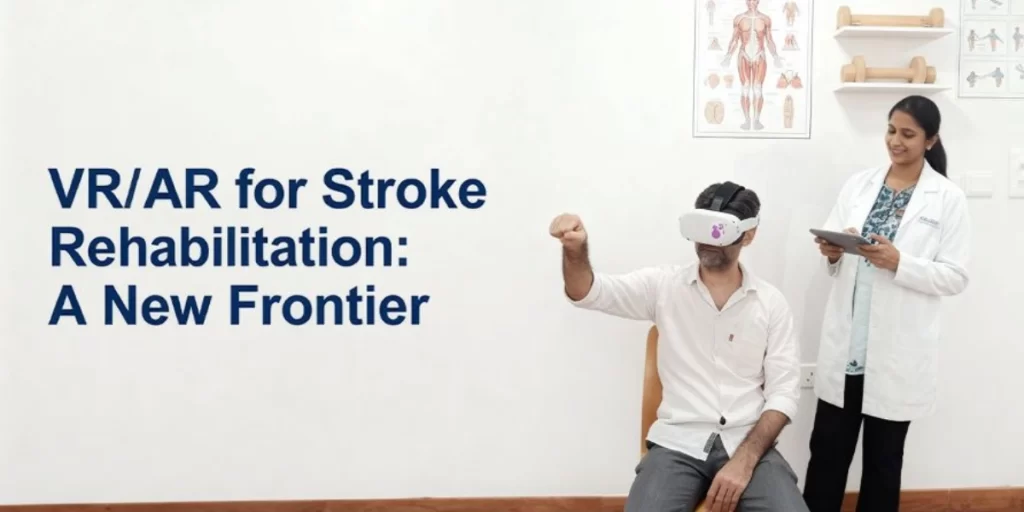
By: SparshMind Innovations | 25th October 2025

Stroke is the second leading cause of death globally, claiming approximately 7 million lives annually, and the third leading cause of death and disability combined, accounting for over 160 million disability-adjusted life-years (DALYs) lost worldwide [1]. Between 1990 and 2021, incident strokes increased by 70%, deaths by 44%, and DALYs by 32% [1]. More than 80% of hospitalized stroke patients experience hemiparesis, leaving survivors with motor, sensory, balance, and cognitive impairments [2].
From Setback to Comeback: The Road to Stroke Recovery
While traditional rehabilitation remains essential, challenges persist: limited therapist resources, patient fatigue, monotony, access constraints, and poor adherence [3]. Virtual reality (VR) and augmented reality (AR) have emerged as transformative tools, creating engaging, controlled environments where patients practice movements and receive immediate feedback [4,5].
How VR/AR Transforms Stroke Rehabilitation
VR enables task-specific repetitive training in safe environments, allowing patients to practice functional tasks without risk of injury [4]. The technology provides individualized practice parameters optimized for motor relearning [6]. The gamified nature of VR exercises counters boredom: 68.4% of patients achieved high satisfaction scores, and 84.2% showed outcomes similar to or better than conventional rehabilitation [5].
VR promotes neuroplasticity through repeated sensorimotor activity. Neuroplasticity is the brain’s ability to change and reorganize itself by forming new neural connections. Even after damage, like a stroke, the brain can adapt by rerouting functions from injured areas to healthy ones. This natural flexibility allows people to relearn skills, regain movement, and recover lost abilities over time. It is like finding an alternate route when the main road is blocked.
Functional MRI studies demonstrate that VR induces cortical reorganization from aberrant ipsilateral to contralateral sensorimotor cortex activation [6,7]. Graph analysis shows VR treatment changes regions related to learning, planning, and motor execution, strengthening frontoparietal networks and connections between motor cortex regions [8].
Home-based VR addresses critical access gaps. While 70% of urban U.S. citizens live within 30 minutes of stroke centres, only 26% of rural residents do[3]. Home-based VR programs yield greater improvements in FMA-UE and hand function compared to standard home therapy [4].
Step into Recovery: VR Training Begins
VR training is usually started in the subacute phase once the patient can actively engage, but it can also complement later-stage therapy to enhance functional recovery and motivation, especially for long-term rehabilitation.
Clinical Evidence
Meta-reviews confirm VR is safe and effective as an adjunct to conventional therapy, improving upper limb, lower limb, gait, and balance outcomes [10]. A meta-analysis of 55 trials (2,142 patients) found VR interventions outperform conventional therapy in motor function, independence, dexterity, spasticity, and quality of life [4].
For lower limbs, meta-analysis of 16 studies (496 participants) showed VR significantly improved mobility with a mean Timed Up and Go score difference of −1.67 seconds, particularly in chronic stroke patients [11]. Dosage matters: ≥20 sessions improved TUG performance by −1.98 seconds, while <20 sessions showed no significant effect [11].
Safety profiles are favourable with minimal adverse events [5]. However, long-term durability and comparative trials remain limited [4].
The Indian Context
In India, stroke ranks as the sixth leading cause of DALYs lost [12], with higher rates in urban areas and states like Goa, West Bengal, and Kerala [12,13]. Stroke patients incur up to INR 50,000 financial burden, with many facing disability in comprehension and speech [14]. The projected global stroke burden will increase dramatically, with deaths rising from 6.6 million to 9.7 million annually by 2050, with 87% of fatal strokes in low- to middle-income countries [1].
ReMind by SparshMind
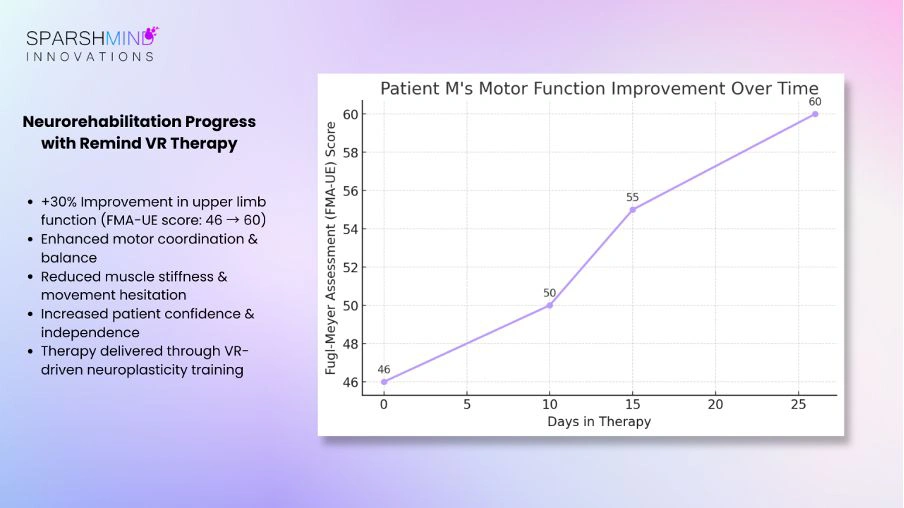
ReMind integrates clinically validated VR/AR protocols benefiting patients and therapists [4,5]. For patients, ReMind offers personalized therapy plans that adapt difficulty based on progress [4,6], engaging AR environments with immediate multimodal feedback [6,8], seamless clinic-home integration with remote guidance [15], and real-time safety monitoring [4,5].
For clinicians, ReMind provides dashboards tracking movement smoothness, completion time, and error rates [4,8], evidence-based protocol libraries following dose-response recommendations (≥6 weeks, ≥20 sessions) [4,11], adaptive progression with clinician override [6,8], and extended reach through remote monitoring [16]. Cost analyses show VR costs are counterbalanced when therapist supervision time is reduced [16].
Future Vision
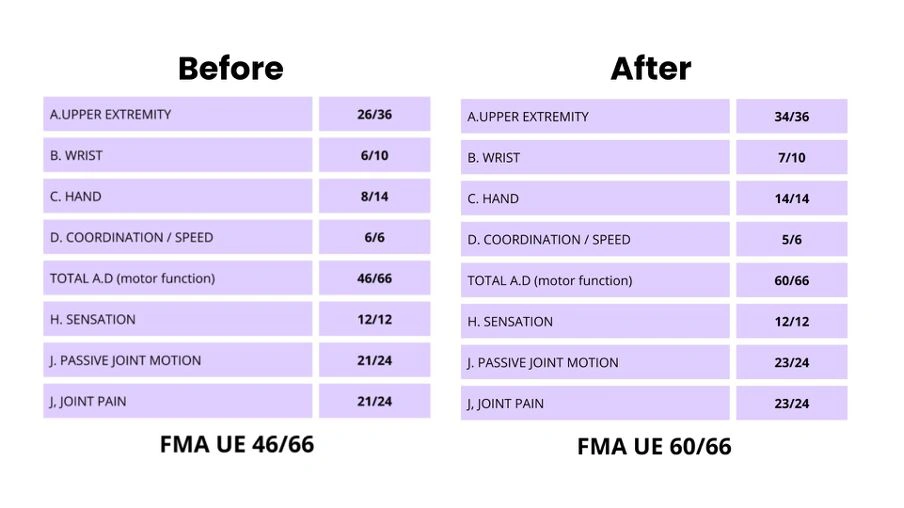
Pilot deployments show improved compliance, consistent therapy doses, and positive feedback [5]. Early results indicate better functional gains than historical controls, with rigorous trials underway [8]. ReMind aims to validate through multicentre trials, integrate AR augmentations, and extend to underserved geographies [3], ultimately complementing standard rehabilitation to elevate outcomes, lower costs, and democratize access [15,16].
SparshMind Innovations and NRF are collaborating on various fronts to make VR and AR-based rehabilitation more accessible and cost-effective. By combining advanced technology with patient-centric design, this collaboration aims to bring innovative therapy to more patients, enabling faster recovery and improved quality of life
References
[1] World Stroke Organization: Global Stroke Fact Sheet 2025 – https://pmc.ncbi.nlm.nih.gov/articles/PMC11786524/
[2] Stroke Recovery Is a Journey – https://pmc.ncbi.nlm.nih.gov/articles/PMC10608684/
[3] Geographic disparities in stroke rehabilitation – https://pmc.ncbi.nlm.nih.gov/articles/PMC12342321/
[4] Virtual reality for stroke rehabilitation – https://pmc.ncbi.nlm.nih.gov/articles/PMC6485957/
[5] Patient satisfaction and tolerance of VR – https://www.frontiersin.org/journals/rehabilitation-sciences/articles/10.3389/fresc.2025.1660766/full
[6] Virtual reality-induced cortical reorganization – https://pubmed.ncbi.nlm.nih.gov/15890990/
[7] VR-Induced Cortical Reorganization (AHA) – https://www.ahajournals.org/doi/10.1161/01.str.0000162715.43417.91
[8] Graph analysis of cortical reorganization – https://www.frontiersin.org/journals/neurology/articles/10.3389/fneur.2023.1241639/full
[9] VR improves functional capacity – https://www.sciencedirect.com/science/article/pii/S0048712025000271
[10] Effects of VR: An umbrella review – https://onlinelibrary.wiley.com/doi/full/10.1002/hsr2.70082
[11] VR-Based Therapies on Lower Limb – https://www.jmir.org/2025/1/e72364
[12] Disability-adjusted life years lost in India – https://bmjopen.bmj.com/content/9/11/e028695
[13] Analyzing stroke burden in India – https://www.nature.com/articles/s41598-024-72551-4
[14] Economic burden of stroke in India – https://www.nature.com/articles/s41598-023-43977-z
[15] Effectiveness of telerehabilitation – https://www.tandfonline.com/doi/full/10.1080/10833196.2024.2400425
[16] Cost-analysis of VR training – https://pubmed.ncbi.nlm.nih.gov/31452469/