
Author: Dr Chittranshi Kaushik, Speech-Language Pathologist | 17th January, 2026

Recently, while waiting at a food counter, I noticed a male staff member announcing order numbers in a noticeably high-pitched voice. As he spoke, people around him laughed, whispered, and even mimicked his voice. He continued his work quietly, but his discomfort was evident. What many bystanders may not realise is that such a voice can be due to a recognised and treatable condition known as puberphonia.
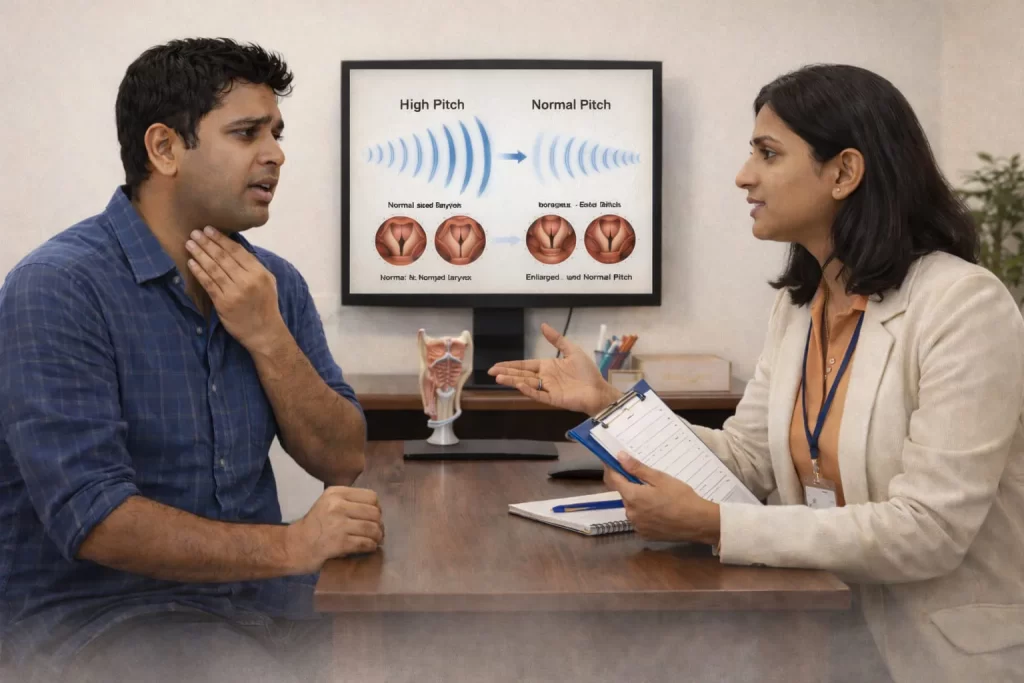
Puberphonia is a functional (psychogenic) voice disorder characterised by the persistent use of a high-pitched, pre-pubertal voice in post-pubescent males despite normal anatomical maturation of the larynx (1). It is also referred to as mutational falsetto, juvenile voice, or incomplete voice mutation. The condition typically emerges during or shortly after puberty, when hormonal changes result in enlargement of the male larynx and a natural lowering of pitch (1)The aetiology of puberphonia is multifactorial.
Although structural abnormalities are usually absent, delayed functional adaptation of the larynx, habitual use of a high pitch, and psychological factors—such as anxiety, emotional stress, or difficulty accepting pubertal changes—are commonly implicated (1). The voice sounds high all the time, may crack in the middle of a sentence, lacks power or turns breathy plus tight. Once the pattern sets, it does not fade on its own. Beyond sound, the man often feels shame, avoids groups and fears speaking at work or school.
Clinically, individuals with puberphonia may present with a consistently high pitch, pitch breaks, reduced vocal loudness, or a strained or breathy voice quality. Beyond the vocal symptoms, the disorder can significantly affect self-esteem, social participation, and professional communication, often leading to embarrassment or social withdrawal (1).
Speech-Language Therapists (SLTs)
Speech and Language therapists play a pivotal role in the assessment and management of puberphonia. Through comprehensive voice evaluation and structured voice therapy, SLTs help individuals achieve an appropriate, stable pitch and efficient voice production. Therapy is supported by vocal hygiene education and, when required, a multidisciplinary approach involving otolaryngologists and mental health professionals (1).
Puberphonia is not a source of amusement—it is a voice disorder with meaningful psychosocial impact and effective treatment options. Increased awareness can help reduce stigma and facilitate timely intervention.
References
Vaidya S, Vyas G. Puberphonia: a novel approach to treatment. Indian J Otolaryngol Head Neck Surg. 2006;58(1):20–21. doi:10.1007/BF02907732